How We Work
Too often, aging out of foster care leads to homelessness and adverse life outcomes. For 33 years, our Five Pillars of Success Program Model has served as our guiding light and the model responsible for positive outcomes for more than 65,000 youth, young adults, and families.
Building a Foundation for Independence, Stability, and Lifelong Success
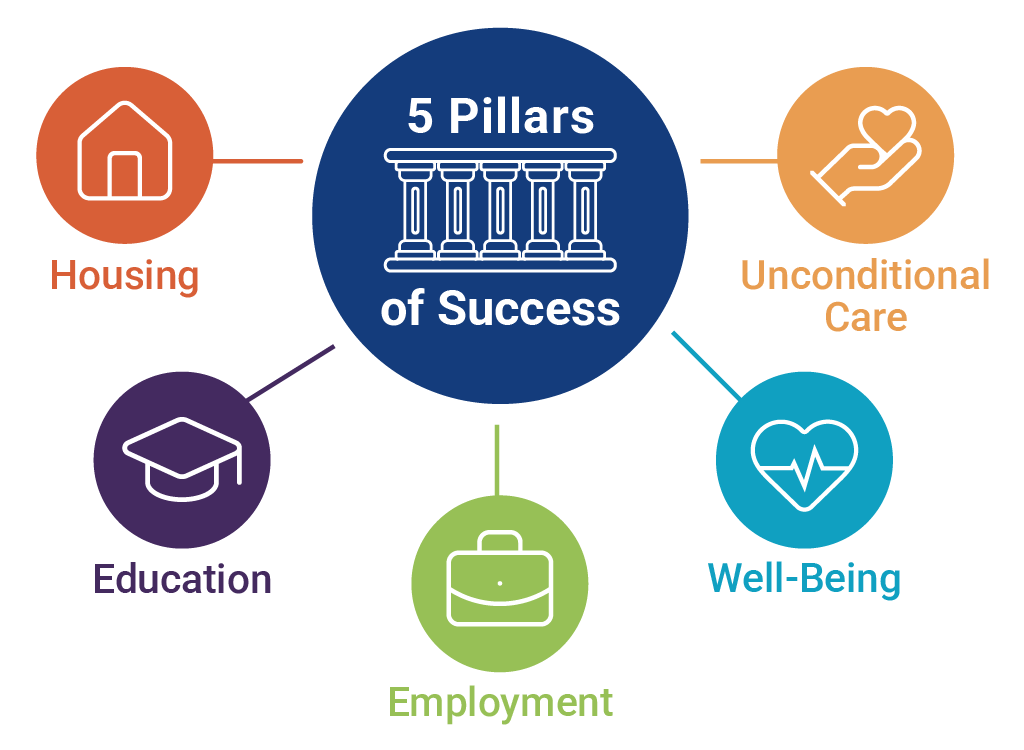
At Unity Care, we believe every young person deserves the opportunity to thrive. Our Five Pillars of Success—Housing, Education, Employment, Well-Being, and Unconditional Care—provide a comprehensive framework to help current and former foster youth overcome barriers, achieve independence, and build brighter futures.

A Foundation for Stability
Many young people transitioning out of foster care face significant challenges in securing stable housing and developing essential independent living skills, including budgeting, financial management, and maintaining a household.
THE CHALLENGE
Research has found that approximately 30% of youth experience homelessness within two years of leaving foster care. Other studies following youth over longer periods have reported higher rates.
UNITY CARE’S COMMITMENT
We provide safe, supportive housing and individualized services that help young people develop the skills, confidence, and resources necessary to achieve long-term housing stability.
FY 2025–2026
88.4%
successful outcomes

Opening Doors to Opportunity
Foster youth face significant educational barriers, including school instability, interrupted learning, and limited access to academic support.
THE CHALLENGE
In California, the 2024–25 high school dropout rate was 20.7% for foster youth, compared with 7.8% for students not in foster care—approximately 2.7 times higher.
UNITY CARE’S COMMITMENT
We help youth pursue high school completion, higher education, vocational training, and educational opportunities that support their personal and professional goals.
FY 2025–2026
78.4%
successful outcomes

Creating Pathways to Financial Independence
Young adults transitioning from foster care often face challenges securing consistent employment, developing workplace skills, and achieving financial independence.
THE CHALLENGE
According to a 2024 UC Berkeley CalYOUTH research report, 58.7% of California foster youth were employed at age 23, compared with 90.4% of their peers in the general population—a 31.7-percentage-point employment gap.
UNITY CARE’S COMMITMENT
Through career readiness, job placement assistance, vocational training, and financial literacy, we empower young people to secure meaningful employment and build sustainable careers.
FY 2025–2026
54.6%
successful outcomes

Supporting Healing and Resilience
Children and youth in foster care may experience significant trauma, abuse, neglect, and instability that can affect their emotional, mental, and physical well-being.
THE CHALLENGE
The Casey National Alumni Study found that 21.5% of former foster youth experienced post-traumatic stress disorder (PTSD), compared with 4.5% of a matched general adult population.
UNITY CARE’S COMMITMENT
We prioritize mental health, emotional well-being, and healing through trauma-informed services, behavioral health support, case management, and meaningful connections that help youth build resilience and confidence.
FY 2025–2026
73.1%
successful outcomes

Building Lifelong Connections
Every young person deserves positive, permanent relationships with caring adults who believe in their potential, stand beside them through challenges, and remain part of their support system.
THE CHALLENGE
A 2025 national longitudinal study reported that approximately 42% of young people in its foster care study population had experienced incarceration by age 20, using the study's definition of incarceration. This highlights the importance of consistent support, positive relationships, and opportunities for successful transitions into adulthood.
UNITY CARE’S COMMITMENT
Our philosophy of Unconditional Care means never giving up on a young person. We build trusting relationships, provide consistent guidance, and connect youth with caring adults and supportive communities that help them navigate life's challenges and celebrate their achievements.
FY 2025–2026
93.1%
successful outcomes

Our Commitment to Youth Success
Through our Five Pillars of Success, Unity Care works to ensure that young people transitioning from foster care have more than temporary support. We help them establish a strong foundation for lifelong independence, meaningful relationships, and a future filled with opportunity.
Because every young person deserves a place to belong, a pathway to success, and someone who will always believe in them.
Kendi’s Story
23-year-old Kendi has been eyeing a career as a paramedic for some time.
As a former foster youth and single mother to two children, ages 4 and 2, she came to us in need of housing and ready to stabilize her future and pursue a dream. Making it through foster care was one challenge. Turning eighteen and learning to navigate adult life on her own with no family connections has been another one.
Sometimes, it feels like the hits keep on coming. And, for roughly 4,000 foster youth in California, that's how it feels to age out of foster care. Foster home placements end, and a newly minted 18-year-old must find secure, safe, and affordable housing and a job, or risk sleeping in their car or on the streets.
-
For Kendi, this was not an option. She had children, and she needed stability. Kendi connected with Unity Care and immediately received our support to find housing in a safe area for herself and her children. Then, it was time to set educational, career, and financial goals. She went back to her dream of being a Paramedic and hasn't looked back.
With Unity Care's donors behind her, she received a partial scholarship to enroll in a full-time, intensive 12-month Paramedic training program. And, with her fantastic case manager, Keyla, Kendi also found a nearby full-time job that pays the bills, and has begun building a small nest egg.
She expects to complete coursework and training hours by March 2026, when she’ll be a certified Paramedic! More importantly, Kendi's career path ensures she will not face homelessness ever again.